SEO Quick Wins: How to Identify and Prioritize Striking Distance Pages
Identify striking distance pages for fast SEO quick wins: selection method, prioritization criteria and concrete actions to climb Google rankings efficiently.
SEO often requires months of sustained effort before delivering measurable results. Yet certain targeted actions can produce visible outcomes in just a few weeks. These rapid optimizations - or SEO quick wins - zero in on the technical and semantic elements most responsive to search algorithms. Here is how to identify, prioritize, and measure these growth levers to maximize your organic traffic.
What is an SEO quick win and why it changes the game
An SEO quick win refers to a technical, semantic, or structural optimization that requires minimal resources while delivering maximum impact on traffic and conversions. In an ecosystem where algorithms constantly evolve, these rapid gains secure short-term visibility. The urgency to act is particularly critical given that 60% of Google searches now result in zero clicks, largely due to the rollout of AI Overviews. Faced with this contraction of clickable real estate in the SERPs, capturing user attention demands surgical precision.
These quick wins focus on existing, already-indexed pages - exploiting latent potential rather than creating content from scratch. They involve fine-tuned adjustments: fixing blocking errors, optimizing tags, or improving internal linking. The goal is not just to attract clicks. You also need to prove the effectiveness of your SEO strategy to decision-makers.
That said, validating the impact of these rapid actions requires analytical rigor. Isolating the real effect of a technical change from seasonality or Google Core Updates remains complex. Gone are the days of “I think it worked.” SearchLens addresses this need by isolating the variables that typically distort SEO measurements: seasonality, natural site growth, overlap between actions, and Google Core Updates. The result is a delta of incremental clicks with a confidence score, allowing you to attribute a traffic increase to a specific action with certainty.
Identifying SEO quick wins: spotting what truly matters
Detecting the most profitable SEO opportunities requires cross-referencing your data. Placing the primary keyword within the first 30 characters of a tag supports better rankings.
Leveraging your data to detect real levers
Identifying quick wins starts with analyzing URLs ranking between positions 4 and 15 in search results. These pages already have authority in Google’s eyes. A slight push is enough to reach the top 3. Prioritize high-traffic or high-conversion-potential pages, such as landing pages tied to paid campaigns. Optimizing these strategic entry points guarantees an immediate return on investment.
Mining historical data helps identify queries with high impression volume but a low click-through rate (CTR). GSC caps exports at 1,000 queries and deletes your data after 16 months. Tools capable of capturing the 50,000+ queries that drive traffic to your site - with unlimited history - make it far easier to proactively detect these performance anomalies.
SearchLens automatically identifies your striking distance pages (positions 4-15) sorted by click potential. No more manual CSV exports from GSC — your quick win list is available in one click. This kind of automated prioritization is what separates teams that act fast from those still buried in spreadsheets two weeks later.
💡 Trouvez vos quick wins SEO en striking distance automatiquement : Voir mes opportunités SEO →
Technical and semantic audit: focus on what matters
A quick-win-focused audit sets aside complex structural overhauls to concentrate on easily fixable technical errors. Analyzing HTTP status codes (404 errors, 301 redirect chains) is the first step to recovering crawl budget.
On international sites, attention should turn to multilingual architecture. Hreflang tags must list all available language versions and self-reference each URL. A syntax error on these tags nullifies their effect and creates indexation conflicts.
On the semantic side, the audit should flag pages suffering from cannibalization. Simply merging URLs or adding canonical tags resolves the issue instantly.
Prioritizing actions: maximum impact without spreading yourself thin
Not all quick optimizations are equal. The effort/impact matrix remains the reference model for ranking SEO initiatives. Set aside actions that require several developer sprints in favor of changes that can be applied directly via the CMS or through minor code tweaks. Give absolute priority to elements blocking search engine crawling or severely degrading the user experience.
Web performance metrics illustrate this urgency perfectly. A one-second delay in LCP (Largest Contentful Paint) is correlated with a 7% drop in conversions. Fixing a hero image’s load time or deferring a third-party script execution then becomes a top-priority quick win.
To structure this prioritization, evaluate each action against precise criteria:
| SEO Action Type | Technical Effort Required | Estimated Indexation Delay | Potential Traffic Impact |
|---|---|---|---|
| Title tag optimization | Low (< 1h) | Fast (2-5 days) | High (Direct CTR boost) |
| Broken link repair (404) | Low (< 2h) | Fast (2-7 days) | Medium (Crawl improvement) |
| Image compression (LCP) | Medium (2-4h) | Medium (1-2 weeks) | High (Conversion uplift) |
| Internal linking to orphan pages | Low (< 2h) | Fast (3-7 days) | High (PageRank distribution) |
SEO quick wins that generate measurable results
Applying specific tactics to precise site elements can produce positive traffic variations within days.
Title tag and meta description optimization: the immediate CTR boost
Updating metadata is the fastest action to directly influence click-through rates in the SERPs. Write descriptive, concise titles while avoiding vague terms like “Home” or “Products.” Keep titles under 60 characters to ensure they display as intended - beyond that length, Google rewrites them in 33.4% of cases.
Incorporating persuasive elements in the meta description, while not directly impacting the ranking algorithm, mechanically increases traffic by capturing user intent ahead of competitors.
Page speed and UX: the performance gains that count
Optimizing load time is a technical lever with direct commercial consequences. A 0.1-second improvement in speed generates 8.4% more conversions. Quick actions include image compression, cache activation, and file minification.
The impact of a smooth interface on user engagement is massive. Tencent Video improved its video CTR by 70% by optimizing its Core Web Vitals metrics. These technical adjustments reduce the bounce rate, sending a strong positive signal to the algorithms.
Strategic internal linking: circulating SEO power
Internal linking acts as the circulatory system of your website, distributing PageRank to strategic URLs. A powerful quick win involves identifying orphan or under-linked pages and pointing links to them from your highest-authority content.
When creating these links, use relevant anchor text. Google uses it to generate title links in search results. Adding a block of contextual links strengthens the search bots’ semantic understanding of the site.
Existing content: turning what already works into more
Refreshing outdated content delivers an immediate SEO gain. Add a paragraph targeting new secondary keywords, update statistics, or integrate a structured FAQ to reignite search engine interest. This approach requires ten times less effort than writing a new article.
Technical cleanup: removing what holds your pages back
Eliminating technical friction unlocks your pages’ potential. When verifying internationalization, ensure each hreflang tag uses absolute, fully qualified URLs including HTTP or HTTPS. Fixing broken internal links is an immediate, essential corrective action.
Conclusion: quick wins, your concrete SEO accelerator
SEO quick wins are the operational arm of a pragmatic digital acquisition strategy. By targeting on-page optimizations, technical error correction, and web performance improvements, you can generate tangible results in record time. These quick wins fund and justify longer-term SEO projects.
However, executing these actions is only part of the equation. The majority of SEO professionals end up saying “I think it worked” without being able to quantify it precisely. SearchLens isolates confounding variables like seasonality and natural growth to provide statistical confidence scores for every action taken. SEO shifts from an uncertain cost center to a scientifically proven growth lever.
Frequently Asked Questions (FAQ)
Find answers to the most common questions about implementing quick wins in organic search.
What exactly is an SEO quick win?
An SEO quick win is a technical or editorial optimization that requires few resources but delivers a fast, positive impact on organic traffic.
Do quick wins replace a long-term SEO strategy?
No - they act as tactical accelerators to capture fast gains, but must sit within a broader strategy that includes content creation and link acquisition.
How long before measuring the impact of an SEO quick win?
Results from a rapid optimization - such as updating a title tag or fixing a technical error - can typically be observed between a few days and three weeks after indexation.
Which tools help identify the quick wins that matter?
Google Search Console is essential for spotting CTR anomalies. But it caps at 1,000 queries and deletes your data after 16 months. Specialized platforms allow you to capture your full dataset and scientifically isolate the impact of each technical action.
Essayez sur ce cas d'usage
Passez de l'analyse manuelle au pilotage SEO en continu
SearchLens agrège vos données Google Search Console, Google Ads et GA4, conserve l'historique complet et fait ressortir ce qui bouge — sans export CSV, sans requête SQL.
Essayer SearchLens — 7 jours sans CBEssai 7 jours · pas de carte bancaire · annulation en 1 clic.
- Historique illimité au-delà des 16 mois de GSC
- Détection automatique des pages en déclin
- Segmentation brand / non-brand en un clic
À lire également
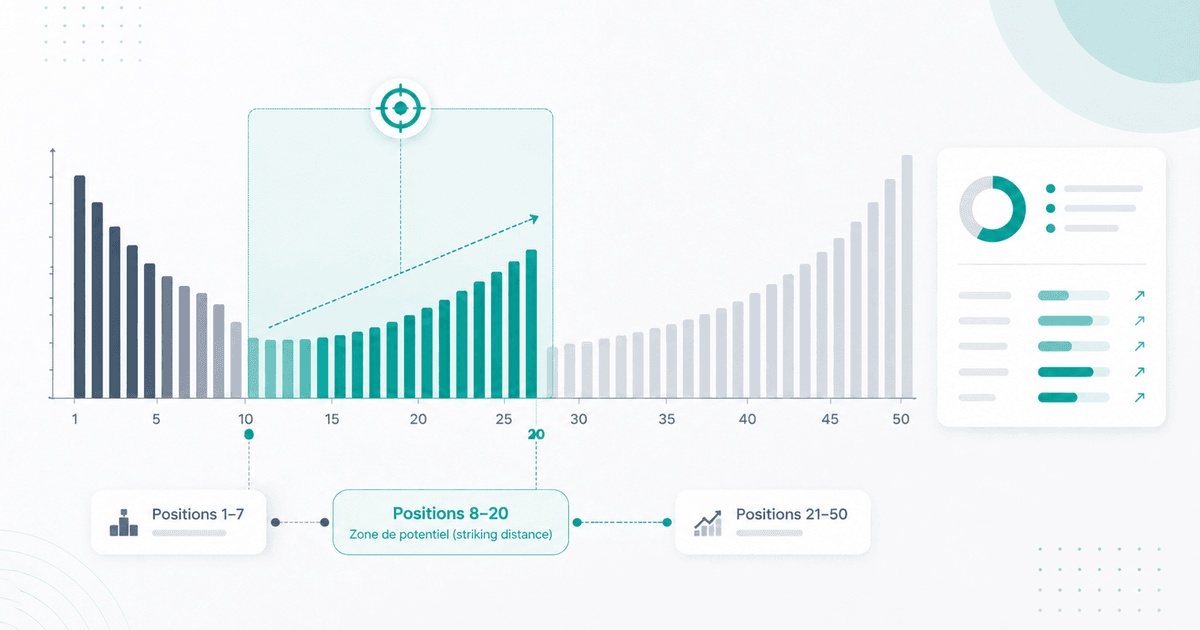
SEO Keyword Optimization: How to Turn Positions 8–20 Into More Clicks
Method to identify striking distance pages (positions 8–20) in GSC, prioritize high-potential URLs, and measure impact without getting misled by seasonality.
SEO Alert Tools: Why Waiting to See the Traffic Drop Is Already Too Late
Set up proactive SEO monitoring to detect traffic drops, technical errors and backlink losses before they impact your revenue and organic visibility.
How to Measure the Real SEO Impact of an Action (Without Confusing Correlation and Causation)
Measure the real SEO impact of your actions without confusing correlation and causation: control groups, measurable hypotheses and business indicators that prove ROI.