SEO Keyword Optimization: How to Turn Positions 8–20 Into More Clicks
Method to identify striking distance pages (positions 8–20) in GSC, prioritize high-potential URLs, and measure impact without getting misled by seasonality.
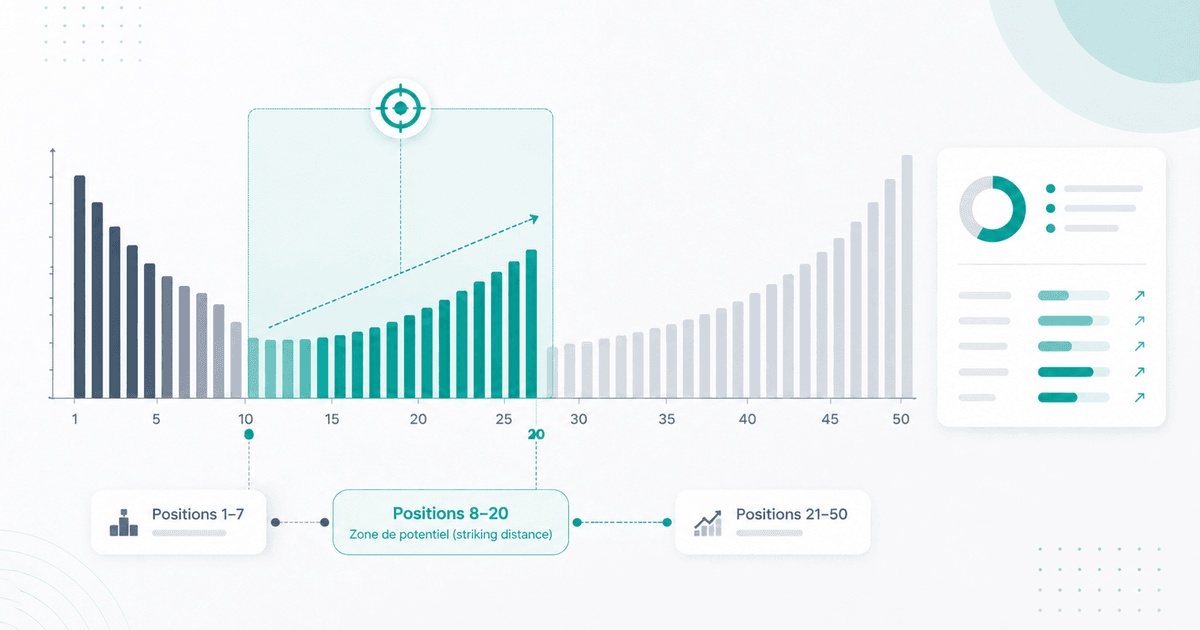
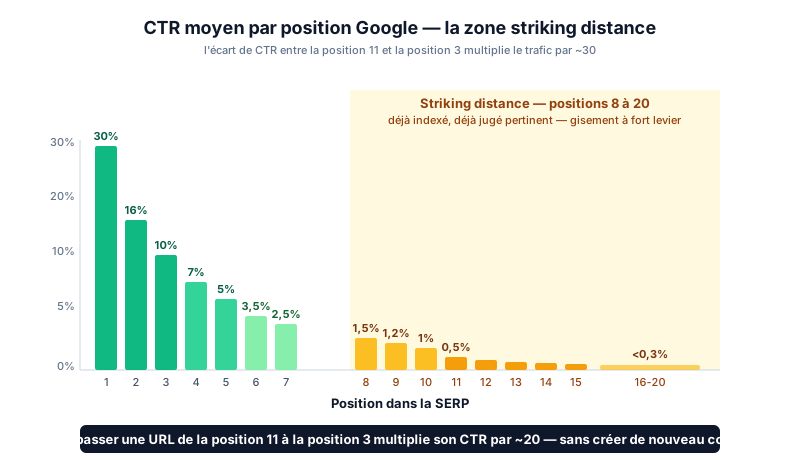
The mathematical reality of SERPs is unforgiving. Position 1 captures an average of 28 to 32% of clicks, position 8 plateaus at 1.5%, and beyond the tenth spot, CTR collapses below 0.5%. In this context, the most profitable strategy is almost never the frantic creation of new content — it’s the optimization of existing pages that are stagnating at the threshold of visibility.
These queries ranking between positions 8 and 20 are what we call the striking distance. Google has already crawled, indexed, and deemed them relevant enough to rank. They just need one more authority signal or semantic depth to break into the top 3. The effort required to move a page from position 11 to position 3 is incomparable to what it takes to rank a brand-new URL from scratch. The potential traffic gain, on the other hand, is exponential.
This article lays out the complete methodology: how to identify these pages in raw data, how to prioritize them without getting tripped up by seasonality or natural drops, and how to measure real impact without confusing causation with coincidence.
Understanding the Foundations of Keyword Optimization
What an SEO Keyword Really Is
A keyword is not a string of characters. It’s the direct interface between a user’s expressed need and the answer your site provides. Technically, it’s the semantic entity around which Google evaluates a page’s relevance during ranking. SEO optimization means aligning a page’s content with Google’s algorithmic expectations for that specific query.
What this means in practice: when a crawler analyzes your code, it extracts recurring terms, evaluates their prominence (title, Hn tags, metadata), and compares everything against its database using natural language processing models. If your page doesn’t explicitly target the expressions your audience uses, it becomes invisible — regardless of its technical quality.
The 4 Keyword Types You Need to Know
To structure your strategy, categorize your queries by volume and specificity:
| Type | Characteristics | Monthly Volume | Avg CTR | Competition |
|---|---|---|---|---|
| Head Terms (generic) | 1-2 words, high ambiguity | > 10,000 | 0.5 – 1.5% | Extreme |
| Middle Tail (mid-range) | 2-3 words, defined intent | 1,000 – 10,000 | 1.5 – 3% | High |
| Long Tail | 4+ words, hyper-specific intent | < 1,000 | 3 – 8% | Moderate |
| LSI / Semantic | Conceptually related terms | Variable | N/A (supporting) | N/A |
Long tail keywords often account for more than 70% of traffic on a mature site. Each expression individually generates few visits, but their aggregation forms a base of qualified traffic that is far less volatile in the face of algorithm updates than head terms.
Search Intent: Your Compass
Since BERT (2019) and then MUM (2021), Google no longer does string matching. It interprets context and underlying intent. Four categories: informational (seeking to know), navigational (seeking an entity), commercial (comparing before buying), transactional (wanting to act now).
Ignoring intent makes any optimization pointless. If a query’s SERP is 100% composed of blog posts (informational intent), ranking a product page (transactional intent) is mathematically a lost cause — regardless of your link profile. Intent analysis involves examining SERP features (Featured Snippet, People Also Ask, video carousels) to reverse-engineer what the algorithm considers the right answer. Your content must adopt the format, depth, and angle demanded by that intent to have any hope of reaching the top of the rankings.
Identifying Your Hidden Opportunities: The Striking Distance
Search Console: Your Gold Mine for Positions 8-20
Google Search Console (GSC) is the foundational tool for auditing your real performance. Unlike third-party tools based on estimates, GSC provides exact click and impression data directly from Google’s servers. Before diving into analysis, a clean GSC setup is non-negotiable — Domain property validated via DNS, sitemap submitted, consistent canonicalization.
To identify your striking distance opportunities, the Performance report is your starting point. Filter positions between 7.9 and 20.1, then sort by impressions descending. You instantly isolate the queries that already have algorithmic visibility but suffer from anemic CTR because they’re not on page 1.
The native interface has one critical constraint: GSC caps exports at 1,000 rows, and the long tail — which is precisely where most opportunities live — falls under the radar. On a catalog of several thousand pages, this cap potentially hides 90% of the opportunity pool. For methods to work around these native limitations, see the complete GSC performance analysis guide. SearchLens connects directly to the official API and BigQuery export to extract the complete dataset.
Why Positions 8-20 Are So Valuable
The value of this zone comes down to one principle: diminishing marginal effort. When a URL ranks at position 12 for a competitive query, it has already passed Google’s most stringent quality filters. Indexability is validated, topical relevance is established, and an initial trust level has been recognized. The gap separating that 12th position from the top 3 is often just a matter of minor on-page adjustments or a slight boost to internal linking.
The CTR math fully justifies this focus. Moving from position 15 (~0.1%) to position 5 (~5%) multiplies traffic by 50 for that query — without creating a single new URL. These keywords already generate real impressions, which proves the existence of active demand. Concentrating your resources on optimizing these queries means maximizing the ROI of your time.
💡 Voir la liste de vos requêtes en striking distance triée par gain potentiel : Voir mes opportunités SEO →
Strategies to Push Your Keywords into the Top 3
Deep Analysis: Don’t Optimize Pages in Natural Decline
Before changing a single line, a diagnostic phase is essential. Seeing that a keyword is at position 11 isn’t enough — you need to understand the dynamics. A page dropping from position 3 to position 11 requires a different remediation strategy than a page climbing from position 30 to position 11. Optimizing a page in natural decline without diagnosing it first is throwing content at a fundamental problem.
For clean prioritization, the analysis must cross-reference three signals: M-1 click delta (short-term dynamics), Y-1 click delta (neutralizes seasonality), and impression-weighted average position (smooths daily volatility). The detailed methodology for detecting declining pages explains precisely how to build and read these three signals.
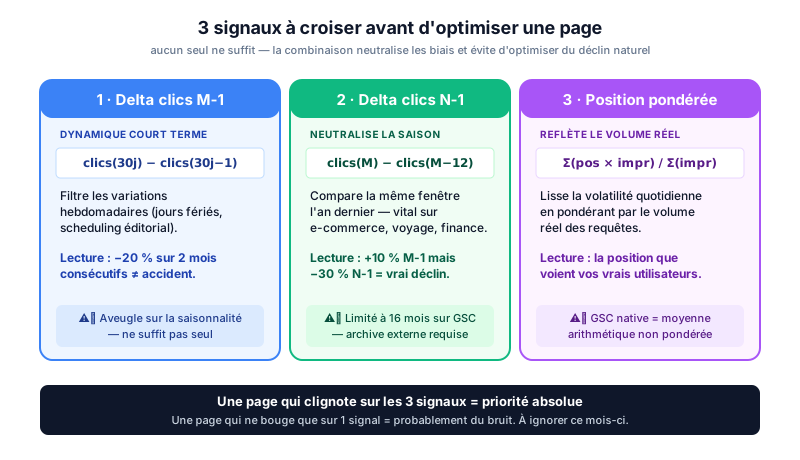
A page that triggers all three signals is an immediate priority. A page that moves on only one is probably statistical noise — ignore it this month.
Improving Existing Content
Semantic improvement is the most direct lever for moving a page from the second to the first page of results. Google evaluates the richness of a text through models based on named entities and weighted frequency. If your page is stuck at position 12, it’s often because it lacks semantic depth compared to the top 3, or because it doesn’t cover underlying questions (People Also Ask) that users are asking.
Four targeted actions:
- Extract the semantic entities present in the top 3 pages and integrate those missing from your text (without stuffing — the goal is to fill gaps, not saturate).
- Increase depth by adding paragraphs that answer frequently asked questions associated with the main keyword (use People Also Ask as your content brief).
- Update stale data: statistics, years, screenshots. The freshness signal (Query Deserves Freshness) plays a role on queries with a temporal component.
- Incorporate multimedia formats (tables, lists, videos) that increase dwell time — a user signal indirectly correlated with rankings.
Optimizing Key On-Page Elements
HTML tags remain the most powerful relevance signals. A poorly calibrated Title tag can single-handedly keep a page stuck at the bottom of page one. The Title should place the target keyword as far left as possible (front-loading), while staying within ~580 pixels wide (55 to 60 characters) to avoid truncation.
The Hn tag structure should reflect a logical hierarchy. The unique H1 contains the primary expression. H2s and H3s incorporate semantic variations and long tail keywords identified in the previous step.
Don’t overlook the meta description: it’s not a direct ranking factor, but a description with a call to action and a unique value proposition can significantly increase your CTR. A CTR above the expected average for a given position is a strong positive signal sent to Google, which favors the URL moving up — this is what closes the virtuous cycle of striking distance.
Building Authority Through Internal Linking
If content determines relevance, links determine authority. A page stuck at position 10 almost always suffers from a deficit of internal PageRank. Internal linking is the most underestimated and most controllable tool in your SEO arsenal: it distributes link equity from your most powerful pages (homepage, popular articles, category pages) to the target pages you want to push up.
Unlike external link building where over-optimized anchors are penalized, internal linking allows and encourages exact-match anchors. If you’re targeting “billing software,” use exactly that anchor text from 5 to 10 thematically related internal pages pointing to your target page.
One caveat: multiplying internal links to the same page can also create side effects. If multiple URLs on your site already rank for the target query, internal linking risks hardening an existing SEO cannibalization issue rather than resolving it. Check this before pushing exact-match anchors.
As a complement, 2 or 3 external backlinks from high-authority domains can provide the final push needed to break into the top 3.
Measuring Real Impact and Neutralizing Bias
Tracking in Search Console: The Impact Timeline
Once optimizations are deployed, the monitoring phase begins. The classic mistake is tracking only average position. In reality, the timeline of SEO impact follows a precise pattern:
- First, impressions increase (Google tests your page on new associated queries).
- Then, average position improves (the page consolidates its signals).
- Finally, clicks follow (the CTR of the new position kicks in fully).
This cycle takes 2 to 6 weeks depending on your crawl budget and domain authority. Drawing conclusions at 7 days consistently leads to abandoning optimizations that would have worked. For the methodological detail, see the Google Search Console pillar guide.
For long-term tracking, there’s a problem: Google deletes your GSC data after 16 months, making year-over-year comparisons impossible over extended periods. This limitation is fatal for sectors with strong seasonality (e-commerce, travel, finance) where Y-1 comparison is the only reliable measure. SearchLens archives continuously and restores the complete history — a stable reference for measuring the evolution of your positions 8-20 over multiple years without any data loss.
Isolating the Cause: The 4 Confounding Variables
SEO ROI measurement is regularly distorted by analytical bias. Seeing a 20% traffic increase after an optimization does not prove causation. That increase could come from a seasonal spike, a broader market trend, a Core Update that benefited your entire domain, or another SEO action running in parallel.
For reliable impact measurement, you need to isolate four variables:
- Seasonality: compare the same window from the previous year (Y-1 delta) to neutralize annual cycles.
- Natural site growth: remove the domain’s baseline trend (other pages following the same growth serve as a baseline).
- Overlap between actions: if you modified 5 pages in the same week, isolating each action’s contribution requires separating the measurement windows.
- Google Core Updates: an algorithm rollout during your measurement window can multiply or divide your traffic independently of any optimization.
Without this neutralization, your reports amount to guesswork. SearchLens automatically isolates these variables and returns an incremental click delta with a confidence score — the first scientifically cleaned SEO impact measurement on the market.
Conclusion: Striking Distance as a Growth Engine
Optimizing positions 8 to 20 is one of the most asymmetric levers in digital marketing. Moderate time investment, potentially massive traffic returns. By shifting your focus from perpetual creation to strategic iteration, you capitalize on the trust history your site has already built with Google.
The success of this strategy rests on four execution pillars:
- Exhaustive data extraction (beyond GSC’s 1,000-row cap).
- Multi-factor signal analysis for stagnation (M-1 delta, Y-1 delta, weighted position).
- Targeted semantic enrichment rather than blind additions.
- Precise internal linking toward target pages, while avoiding hardening cannibalization cases.
But above all, you need to move from a culture of intuition to a culture of proof. By equipping yourself with tools capable of working around the native limitations of traditional platforms and isolating external variables, you transform SEO into a predictable acquisition channel. Mastering this methodology doesn’t just win clicks in the short term — it consolidates lasting topical authority, capable of withstanding Google’s future algorithmic fluctuations.
Frequently Asked Questions
What is SEO keyword optimization?
It’s the process of adjusting a page’s content, HTML tags, and authority to improve its Google ranking for specific queries. The goal is to align the page with the search intent of targeted users, prioritizing queries where the page is already visible but underperforming.
How do I identify high-potential keywords in Google Search Console?
In the Performance report, filter queries to show only those with an average position between 8 and 20. Then sort by impressions descending to prioritize the terms generating the most demand. Watch out for the native 1,000-row cap: on sites with large catalogs, the Search Analytics API or BigQuery export are essential to avoid missing long tail opportunities.
What are the advantages of targeting positions 8-20 over writing new content?
These keywords offer the best ROI because the page is already indexed and deemed relevant by Google. Targeted optimization (Title, semantic depth, internal linking) is often enough to push the page into the top 3, multiplying CTR by 10 to 50 depending on the starting position. Creating a new URL requires earning crawl, indexation, and algorithmic trust from scratch — a 6 to 12-month cycle with no guarantees.
How long does it take to see results from an optimization?
The first signals (impression increases) can appear within days of the crawler revisiting the page. Stabilization of the new position and a significant increase in clicks generally takes 2 to 6 weeks. Drawing conclusions at 7 days consistently leads to abandoning optimizations that would have eventually worked.
Essayez sur ce cas d'usage
Trouvez les opportunités CTR que Google Search Console vous cache
Les requêtes où vous êtes page 1 position 4-10 avec un CTR faible, les pages sous-exploitées, les intents mal couverts : SearchLens les liste triées par potentiel de clics.
Voir mes opportunités SEO →Essai 7 jours · pas de carte bancaire · annulation en 1 clic.
- Requêtes position 4-10 triées par gain CTR potentiel
- Analyse au-delà des 1000 lignes visibles dans GSC
- Croisement avec les données Google Ads si connecté
À lire également
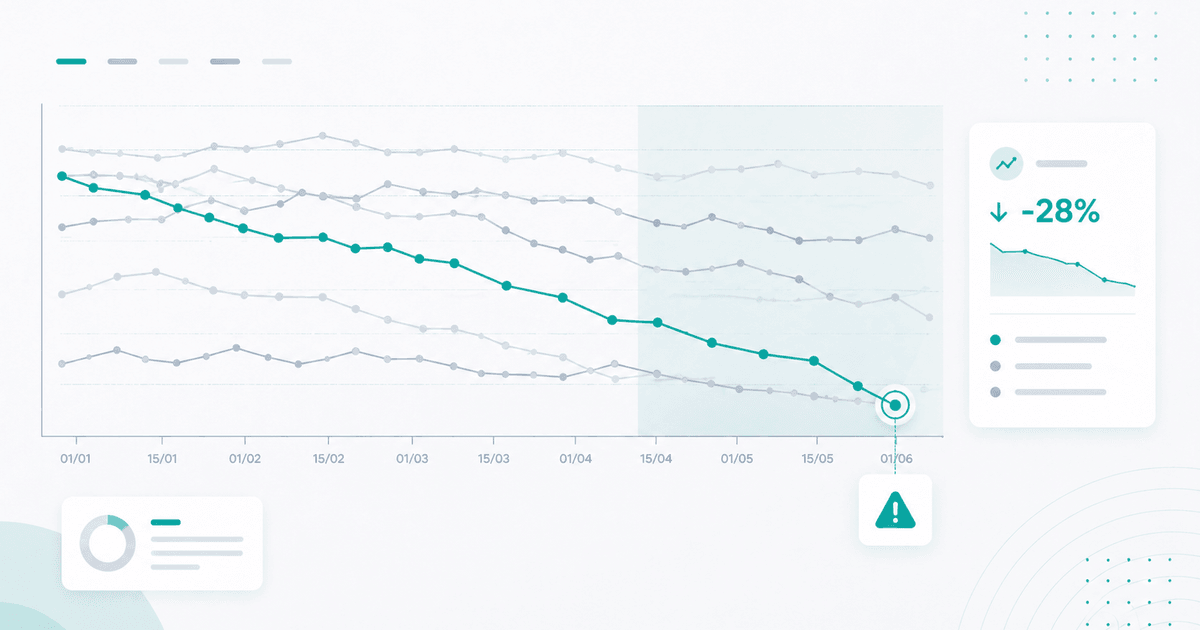
How to Detect Your Declining Pages in Google Search Console (Without Spending Two Hours in Excel)
A repeatable workflow to spot pages losing clicks vs. last month or last year, identify the queries behind the drop, and prioritize the actions that will actually move the needle.
How to Measure the Real SEO Impact of an Action (Without Confusing Correlation and Causation)
Measure the real SEO impact of your actions without confusing correlation and causation: control groups, measurable hypotheses and business indicators that prove ROI.
SEO Quick Wins: How to Identify and Prioritize Striking Distance Pages
Identify striking distance pages for fast SEO quick wins: selection method, prioritization criteria and concrete actions to climb Google rankings efficiently.