Measuring SEO Profitability: How to Calculate ROI and Prove It to Your Clients
Calculate and prove SEO ROI to your clients: financial formulas, business KPIs, attribution tools and dashboards that speak revenue, not technical metrics.
Measuring SEO Profitability: How to Calculate ROI and Prove It to Your Clients
Proving the value of an organic search strategy requires rigorous mathematics, not traffic promises. With finance teams demanding tangible results, measuring SEO profitability has become an absolute necessity to justify allocated budgets. This article details the scientific methods, financial indicators, and technical tools needed to calculate an indisputable ROI.
Measuring SEO Profitability: Why It Has Become Essential for Your Clients
The days when agencies and consultants could get away with presenting upward-trending traffic charts are over. Today, executive teams demand strict accountability for every euro invested. The digital advertising market was worth €10.97 billion in 2024 (https://www.sri-france.org/observatoire-epub/33eme-observatoire-de-le-pub/). In this highly competitive ecosystem, organic search must prove its ability to generate revenue against paid acquisition channels whose return on investment appears - rightly or wrongly - more immediate and easier to trace.
32.9% of internet users over 16 discover new brands through search engines (https://www.hubspot.com/marketing-statistics). This volume of potential acquisition is enormous. But without precise profitability measurement, it is impossible to justify maintaining or increasing SEO budgets. Your clients need to know whether the €5,000 or €10,000 invested monthly in content creation, technical optimization, and backlink acquisition translates into real net margin growth.
Measuring SEO profitability transforms what is perceived as a cost center into a genuine business asset. This radically changes the client relationship: you are no longer selling keyword rankings, but a predictable, scalable, and financially viable acquisition channel.
The Real Challenges of Evaluating SEO ROI (and Why “It Works” Is No Longer Enough)
Assessing the financial impact of organic search runs into major analytical obstacles that make simplistic approaches obsolete.
Conversion Attribution: When Multiple Channels Overlap
The modern B2B buying journey is fragmented and non-linear, involving on average between 7 and 13 touchpoints before a contract is signed. A prospect may discover your business through an SEO-positioned blog post, return three weeks later via a retargeting campaign, and ultimately convert by typing the website URL directly. In this context, attributing 100% of the credit to the last click completely distorts the profitability analysis. Adopting multi-touch attribution models is essential to accurately evaluate the different touchpoints (https://digital.hec.ca/blog/le-roi-des-medias-sociaux-peut-il-etre-mesure-de-maniere-fiable/). These mathematical models (linear, time decay, or data-driven) distribute conversion value across all channels that contributed to lead nurturing, revealing the true weight of SEO in initiating the sales funnel.
The Time Effect and the Compounding Impact of SEO
Unlike advertising campaigns that stop the moment the budget runs out, SEO is a compounding-return asset. An optimized page published today may take 3 to 6 months to reach its full visibility potential, but will continue generating qualified leads for years with near-zero marginal maintenance cost.
The challenge is to isolate this real impact from external fluctuations. Traffic variations can be caused by seasonality, natural brand growth, or Google’s Core Updates. Platforms like SearchLens solve this problem by isolating these confounding variables to provide reliable impact measurements with statistical confidence scores. No more “I think it worked.”
💡 Prouvez le ROI SEO avec des données statistiquement fiables : Tracer l'impact de mes actions →
SearchLens translates GSC metrics into measurable business impact. Instead of presenting traffic curves and hoping your audience draws the right conclusions, you get hard numbers: incremental clicks, revenue delta, and a statistical confidence score that holds up in front of a CFO. No more guesswork — just evidence you can put in a client report or bring to your management team.
This scientific approach allows you to prove that the revenue increase is a cause-and-effect relationship tied to SEO actions - not a mere coincidental correlation.
The KPIs That Actually Matter to Prove Performance
To demonstrate the value of your strategy, you must abandon vanity metrics in favor of financial indicators directly tied to the company’s income statement.
Qualified Organic Traffic and Conversions: Beyond Simple Clicks
A monthly volume of 100,000 visitors has no value if it generates no revenue. The analysis must focus on qualified organic traffic, measured by engagement rate and conversion rate by page type. An informational blog post may show a conversion rate of 0.5%, while a transactional page targeting a bottom-of-funnel (BOFU) search intent should aim for rates between 3% and 8%.
Segment the data to identify which semantic clusters are actually generating qualified leads (MQLs) and business opportunities (SQLs). By cross-referencing traffic volume with the specific conversion rate of each thematic cluster, you obtain a reliable projection of the commercial pipeline generated by organic search.
CAC vs. LTV: Real Profitability Per Acquired Customer
The ratio between customer acquisition cost (CAC) and customer lifetime value (LTV) is the ultimate SEO profitability indicator. In B2B SaaS, a healthy LTV:CAC ratio should exceed 3:1. SEO particularly excels on this metric because, once positions are acquired, the marginal cost of a new visitor is zero, which mechanically drives down CAC over time.
| Financial Metric | Technical Definition | Standard B2B Target | Long-term SEO Impact |
|---|---|---|---|
| Organic CAC | Total SEO spend / New SEO customers | < 33% of LTV | Continuous decline after 12 months |
| LTV (Lifetime Value) | Average monthly revenue x Customer lifespan | > 3x CAC | Stable or rising (upsell) |
| Payback Period | Time required to recoup CAC | < 12 months | Accelerated through passive traffic |
| Net SEO Margin | (SEO Revenue - SEO Costs) / SEO Revenue | > 60% | Exponential increase |
By demonstrating that organic CAC systematically becomes lower than paid channel CAC after the 8th or 10th month of investment, you mathematically justify the case for a long-term vision.
How to Concretely Calculate the ROI of Your SEO Actions
Calculating return on investment requires accounting rigor to accurately assess the spending incurred and the gains generated.
Identifying and Precisely Quantifying Your SEO Investment
The first step in the calculation is to consolidate all costs related to your organic visibility strategy. This is not just the agency invoice. You must include the fully loaded salaries of internal resources (writers, developers, project managers), content production costs, budgets allocated to backlink acquisition, and analytics tool licenses.
Search advertising investment in France reached €4.1 billion in 2024 (https://www.statista.com/topics/9290/digital-advertising-in-france/). Against these enormous sums spent on paid search, the SEO investment (often between €2,000 and €15,000 per month for an SME) must be documented with the same surgical precision. A technical audit billed at €5,000 and amortized over 12 months represents a monthly cost of €416. This level of granularity allows you to establish the exact denominator of your ROI formula.
Isolating Revenue Directly Attributable to SEO
The second step is to quantify the financial gains. For an e-commerce site, measurement is direct through organic transaction tracking. For a B2B company generating leads, the calculation requires assigning a monetary value to each conversion.
The formula is: (Number of organic leads) × (Lead-to-customer conversion rate) × (Average customer value or LTV). If SEO generates 50 leads per month, 10% sign a contract, and LTV is €10,000, the attributable revenue is €50,000.
The final ROI calculation is expressed as: ((Revenue attributable to SEO - Total SEO cost) / Total SEO cost) × 100. A result of 300% means that every euro invested returns three. This precise figure, free from any approximation, is what will validate the profitability of your actions to decision-makers.
Tools to Capture and Analyze Your Performance Data
A scientific measurement of profitability requires a robust technology stack capable of collecting, cleaning, and interpreting massive volumes of data.
Google Analytics 4 and Search Console: The Solid Foundation
The Google ecosystem remains the indispensable foundation of any traffic analysis. Google holds 86.81% market share in France as of March 2026 (https://digitiz.fr/statistiques-seo/). Google Search Console (GSC) provides the raw impression and click data essential for assessing technical health and page visibility.
GA4, for its part, has revolutionized conversion tracking. GA4’s data-driven attribution model uses machine learning algorithms (https://support.google.com/analytics/answer/10597962?hl=fr). This algorithmic approach analyzes real conversion paths to dynamically distribute credit, offering a far more realistic view of organic impact than the old last-click model.
However, these native tools have structural limitations: GSC history is capped at 16 months, exports are limited to 1,000 queries, and they are unable to natively link an anonymous visitor to a finalized B2B revenue figure.
Specialized SEO Platforms and CRM Integration
To bridge the gaps of free tools and prove financial ROI, integration with the company’s CRM (Customer Relationship Management) system is vital. Solutions like HubSpot or Salesforce allow you to track a lead from their first organic visit through to contract signing, calculating the exact revenue generated.
In parallel, the use of advanced SEO intelligence platforms is required for experts. SearchLens transforms GSC into an intelligent platform with unlimited history, automatic alerts, and proactive issue detection. Google erases your GSC data after 16 months. SearchLens archives everything, forever. By offering the market’s first scientific SEO impact measurement, the tool allows you to move beyond guesswork. Instead of wondering whether a traffic increase is due to your optimizations or a seasonal trend, you get a delta of incremental clicks with a statistical confidence score.
Building Client Dashboards That Speak Business
Data reporting must be tailored to the audience. A CFO is not interested in the number of backlinks acquired or 404 error fixes. Build dashboards (via Looker Studio or Power BI) that translate technical metrics into business indicators.
| KPI Type | Technical Metric (For the SEO Expert) | Business Metric (For the Client/CFO) |
|---|---|---|
| Acquisition | Non-brand impression and click growth | Organic MQL volume trend |
| Efficiency | Click-through rate (CTR) in SERPs | Organic Cost Per Lead (CPL) |
| Conversion | Bounce rate and time on page | MQL-to-SQL conversion rate |
| Profitability | Top 3 keyword rankings | Commercial pipeline generated in euros |
By structuring your reports around these equivalences, you demonstrate that every optimization action has a measurable economic purpose.
Optimizing Your Strategy to Maximize Return on Investment
Measuring SEO profitability is not an end in itself - it is the starting point of a continuous improvement cycle. Once ROI is calculated, the goal is to optimize it by allocating resources toward actions with the greatest financial leverage. This often means pivoting from a volume strategy to a precision strategy.
Conversion data analysis typically reveals that 80% of organic revenue comes from 20% of pages. Conversion rate optimization (CRO) on these strategic pages then becomes the priority. Increasing a page’s conversion rate from 1.5% to 2.5% generates 66% growth in leads without requiring a single additional visitor.
Also identify semantic “quick wins”: keywords ranking between 4th and 10th position that carry strong purchase intent. A targeted effort on internal linking or acquiring a few authoritative links to these specific pages can push the content into the top 3, multiplying traffic by a factor of 3 to 5.
Finally, budget rationalization involves “pruning” obsolete or underperforming content that consumes crawl budget without generating value. Focus investment on the most profitable thematic silos.
SEO as a Measurable Growth Lever: No More Guesswork
The digital marketing industry has reached a level of maturity that no longer tolerates opacity. The global digital advertising market in France is expected to reach €12.5 billion in 2025 (https://lareclame.fr/sri-udecam-oliver-wyman-observatoire-de-lepub-2025-programmatique-319257). To capture a share of these investments, organic search must align with the measurability standards of other channels.
By combining rigorous attribution models, financial analysis of CAC and LTV, and statistical intelligence tools capable of isolating algorithmic noise, you transform SEO into an exact science. Proving the profitability of your actions is no longer an insurmountable challenge - it is the competitive advantage that will retain your clients over the long term by demonstrating your direct impact on their economic growth.
Frequently Asked Questions About SEO Profitability
How Do You Precisely Measure SEO Profitability?
Apply the standard financial formula: ((Revenue generated by SEO - Total SEO costs) / Total SEO costs) × 100. Use data-driven attribution models to isolate the exact value of organic conversions within multi-channel journeys.
Which Indicators Should You Track First?
Drop vanity metrics and focus on organic Customer Acquisition Cost (CAC), Customer Lifetime Value (LTV), qualified lead volume (MQL/SQL), and revenue directly attributable to the search channel.
How Long Before Seeing a Positive ROI?
The financial break-even point (Payback Period) is generally reached between 6 and 12 months of continuous investment. This timeframe varies depending on the site’s initial technical debt, the competitive intensity of the sector, and the existing domain authority.
SEO vs. Paid Advertising: Which Channel Should You Prioritize?
Search accounted for 41% of digital advertising market share in the first half of 2025 (https://www.blogdumoderateur.com/publicite-digitale-france-chiffres-cles-t1-2025/). Display advertising also grew by 17% across the full year 2024 (https://www.sri-france.org/observatoire-epub/33eme-observatoire-de-le-pub/). Both channels are complementary: paid search delivers immediate acquisition, while SEO builds exponential and lasting profitability.
Essayez sur ce cas d'usage
Passez de l'analyse manuelle au pilotage SEO en continu
SearchLens agrège vos données Google Search Console, Google Ads et GA4, conserve l'historique complet et fait ressortir ce qui bouge — sans export CSV, sans requête SQL.
Essayer SearchLens — 7 jours sans CBEssai 7 jours · pas de carte bancaire · annulation en 1 clic.
- Historique illimité au-delà des 16 mois de GSC
- Détection automatique des pages en déclin
- Segmentation brand / non-brand en un clic
À lire également
How to Measure the Real SEO Impact of an Action (Without Confusing Correlation and Causation)
Measure the real SEO impact of your actions without confusing correlation and causation: control groups, measurable hypotheses and business indicators that prove ROI.
How to Isolate SEO Seasonality from the Effect of Your Optimization Actions
Isolate organic traffic seasonality to measure the real impact of your SEO actions: statistical methods, tools and anticipatory editorial calendar to stop guessing.
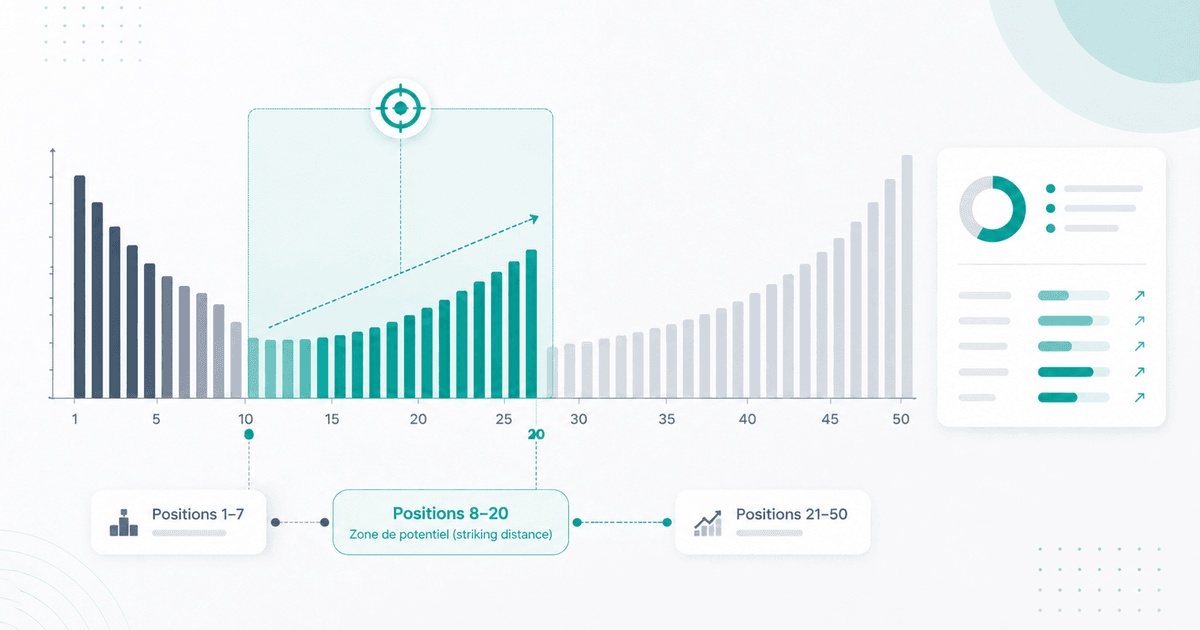
SEO Keyword Optimization: How to Turn Positions 8–20 Into More Clicks
Method to identify striking distance pages (positions 8–20) in GSC, prioritize high-potential URLs, and measure impact without getting misled by seasonality.