How to Isolate SEO Seasonality from the Effect of Your Optimization Actions
Isolate organic traffic seasonality to measure the real impact of your SEO actions: statistical methods, tools and anticipatory editorial calendar to stop guessing.
How to Isolate SEO Seasonality from the Effect of Your Optimization Actions
Accurately measuring the return on investment of organic search requires absolute analytical rigor. To evaluate the real effectiveness of your optimizations, you must isolate organic traffic seasonality from the natural fluctuations of the market. This article details the statistical methodologies and technical tools that allow you to seasonally adjust your data and get a clear picture of your SEO performance.
Understanding Organic Traffic and the Influence of Seasonality
Seasonal adjustment is a fundamental step in data analysis. It prevents misinterpretation and makes time periods directly comparable. By smoothing out cyclical variations, you can finally observe the underlying trend of your website.
Definition of Organic Traffic
Organic traffic refers to all visitors landing on a website’s pages via the unpaid results of search engines. This acquisition metric is measured by the volume of clicks and impressions generated by user queries. Unlike paid sources, organic search is a long-term strategy where content quality, technical optimization, and backlink acquisition determine overall visibility.
What Is SEO Seasonality and How Does It Manifest?
SEO seasonality translates into predictable, recurring fluctuations in search volume for specific keywords throughout the year. A traffic drop occurring at the exact same time the previous year is most likely seasonal in origin - not the result of an algorithmic penalty. These variations directly impact the number of visits and conversion rate, regardless of the optimization efforts invested.
Why This Distinction Matters for Your SEO Strategy
Confusing a seasonal dip with a technical performance loss leads to poor decision-making. Unnecessary blog article rewrites, modifications to a sound architecture: these actions waste time and resources. SEO intelligence platforms like SearchLens address this challenge by isolating confounding variables (seasonality, natural growth, Google Core Updates) to deliver reliable impact measurements with statistical confidence scores.
💡 Isolez l'effet saisonnalité de l'effet de vos actions SEO : Tracer l'impact de mes actions →
SearchLens statistically isolates the seasonality effect from the SEO action effect. Each optimization is annotated directly on the traffic curve, with a confidence score that proves whether it was your actions or the season that moved the numbers. You stop guessing and start making decisions based on evidence.
This distinction allows you to allocate your marketing resources toward actions that generate a genuine return on investment.
Methods for Identifying and Analyzing Seasonality
Accurately identifying seasonal cycles requires a multi-factor approach. Cross-reference multiple data sources to validate your fluctuation hypotheses.
Key Tools for Detecting Seasonal Trends
For comprehensive detection, combine the proprietary data from Google Search Console or Google Analytics with the macroscopic trends from Google Trends and the Keyword Planner.
Here is a comparison of the relevant tools for this analysis:
| Analysis Tool | Primary Function | Usefulness for Seasonality |
|---|---|---|
| Google Search Console | Tracking real performance | Analyzing clicks and impressions on exact queries |
| Google Analytics | Measuring user behavior | Tracking variations in traffic, audience, and conversion |
| Google Trends | Analyzing search interest | Visual identification of seasonal peaks over 5 years |
| Keyword Planner | Keyword planning | Obtaining historical monthly search volumes |
Analyzing Historical Data and Recurring Patterns
Periodicity analysis requires sufficient historical perspective. Extend the date range to at least 16 months in your reports to correctly contextualize traffic drops. This depth of history allows you to verify whether an audience decline observed in a given month had already occurred the previous year. The diagnosis is then clear: seasonal nature confirmed, no degradation in market positioning.
The Different Types of Seasonality and Their Causes
Temporal variations fall into several distinct categories. Modern statistical algorithms distinguish purely seasonal factors (linked to climate or time of year) from calendar effects such as public holidays, leap years, or one-off events.
The main types of variations include:
-
Calendar seasonality: tied to months of the year (e.g., Christmas shopping in December).
-
Weekly seasonality: variations between weekdays (B2B) and weekends (B2C).
-
One-off events: sales periods, Black Friday, or major sporting events.
Isolating the Real Impact of Your SEO Actions from Seasonal Variation
Mathematically separating the signal (the impact of your actions) from the noise (seasonality) requires applying rigorous analytical methods and proven statistical models.
Precise Tracking of SEO Performance Metrics
To avoid aggregation bias, segment your data by query, country, and device to identify targeted drops. A global traffic analysis often masks underlying dynamics: a rise in mobile traffic on informational queries can artificially offset a fall in desktop traffic on transactional queries. Seasonality isolation must be performed at the semantic cluster or page directory level to obtain actionable performance indicators.
Comparative Analysis Techniques (Year-over-Year, Period-over-Period)
Comparative analysis is the first step in seasonal adjustment. Use the Compare tab in Google Search Console with the custom date selection option to align dates precisely. When doing this, always compare the same number of days and the same days of the week. Compare Monday-to-Sunday of year N with Monday-to-Sunday of year N-1. A single weekend day offset can skew the analysis for a B2B site whose traffic drops by 70% on Saturdays and Sundays.
Using Annotations and Segments to Contextualize Data
Contextualizing raw data is essential for interpreting variations. Adding annotations in your analytics tools allows you to mark dates of technical deployments, new content publications, major backlink acquisitions, or Google algorithm updates. By cross-referencing these annotated segments with traffic curves, you can visually correlate a trend break with a specific SEO action, independently of the current seasonal cycle.
Introduction to Statistical Seasonal Adjustment Models
For a scientific approach, two models stand out. The additive model (where seasonality is constant: Y = Trend + Seasonality + Residual) and the multiplicative model (where seasonality is proportional to the trend: Y = Trend × Seasonality × Residual) allow you to calculate seasonal coefficients.
The formula for estimating the seasonally adjusted series is expressed as Ycvs = Yt - Ŝt, where Yt represents the observed value and Ŝt the estimate of the seasonal component. The moving average method is the simplest way to eliminate seasonality by smoothing data over 12 months. But professionals rely on more robust approaches: the X13-Arima and Tramo-Seats algorithms decompose the time series with mathematical precision, making it possible to isolate the net impact of optimizations on search engines.
Optimizing Your SEO Strategy Through Seasonally Adjusted Analysis
Once seasonality is isolated, adjusted data becomes the foundation for a proactive SEO strategy and optimal resource allocation.
Adapting Your Editorial Calendar and Marketing Campaigns
Precise knowledge of seasonal cycles allows you to anticipate content production. Since search engines require an indexation and ranking delay, your articles and commercial pages must be optimized and published 60 to 90 days before the identified query peak. This anticipation ensures that the site will capture the maximum volume of users when organic demand reaches its apex.
Adjusting SEO Investments and Resources
Seasonally adjusted analysis reveals the true profitability of your technical and semantic actions. If traffic adjusted for seasonal variations (Ycvs) shows stagnation despite an apparent rise in raw visits, the conclusion is unambiguous: the current strategy is underperforming. Budgets allocated to link building or technical overhaul can thus be reassessed and redirected toward areas of the site that show genuine structural growth potential.
Improving Performance Forecasting and Reporting
An SEO report based on raw data often generates unrealistic expectations or unjustified panic among clients or management. By integrating seasonal coefficients into your forecasting models, you establish realistic traffic and sales objectives. Reporting then becomes a strategic management tool. It demonstrates the incremental impact of your optimization work beyond simple market fluctuations.
Conclusion: Mastering Seasonality for Higher-Performing SEO
Isolating organic traffic seasonality is not a stylistic exercise. It is an absolute necessity for evaluating the real performance of your SEO strategy. By applying rigorous statistical models and comparing equivalent periods, you eliminate interpretation bias. Using a platform like SearchLens automates this scientific impact measurement. You justify your SEO investments with reliable data and focus on the actions that generate genuine structural growth. No more “I think it worked.”
Frequently Asked Questions
What is a seasonality period?
A seasonality period corresponds to a fixed time interval (often annual, quarterly, or monthly) during which recurring and predictable variations in user behavior and search volumes are observed.
What is the definition of organic traffic?
Organic traffic represents all visitors who access a website by clicking on the natural (non-sponsored) results offered by search engines in response to a query.
What is an example of seasonality?
A classic example of seasonality is the explosion of queries for “swimsuits” in June and July, followed by a sharp drop in November and December. This phenomenon occurs independently of the e-commerce site’s SEO optimizations.
How does seasonal adjustment improve SEO planning?
Subtracting the seasonality estimate allows you to more accurately estimate the true underlying growth trend of a site. You plan your actions based on structural performance rather than cyclical anomalies. The delta becomes measurable.
Essayez sur ce cas d'usage
Passez de l'analyse manuelle au pilotage SEO en continu
SearchLens agrège vos données Google Search Console, Google Ads et GA4, conserve l'historique complet et fait ressortir ce qui bouge — sans export CSV, sans requête SQL.
Essayer SearchLens — 7 jours sans CBEssai 7 jours · pas de carte bancaire · annulation en 1 clic.
- Historique illimité au-delà des 16 mois de GSC
- Détection automatique des pages en déclin
- Segmentation brand / non-brand en un clic
À lire également
How to Measure the Real SEO Impact of an Action (Without Confusing Correlation and Causation)
Measure the real SEO impact of your actions without confusing correlation and causation: control groups, measurable hypotheses and business indicators that prove ROI.
Measuring SEO Profitability: How to Calculate ROI and Prove It to Your Clients
Calculate and prove SEO ROI to your clients: financial formulas, business KPIs, attribution tools and dashboards that speak revenue, not technical metrics.
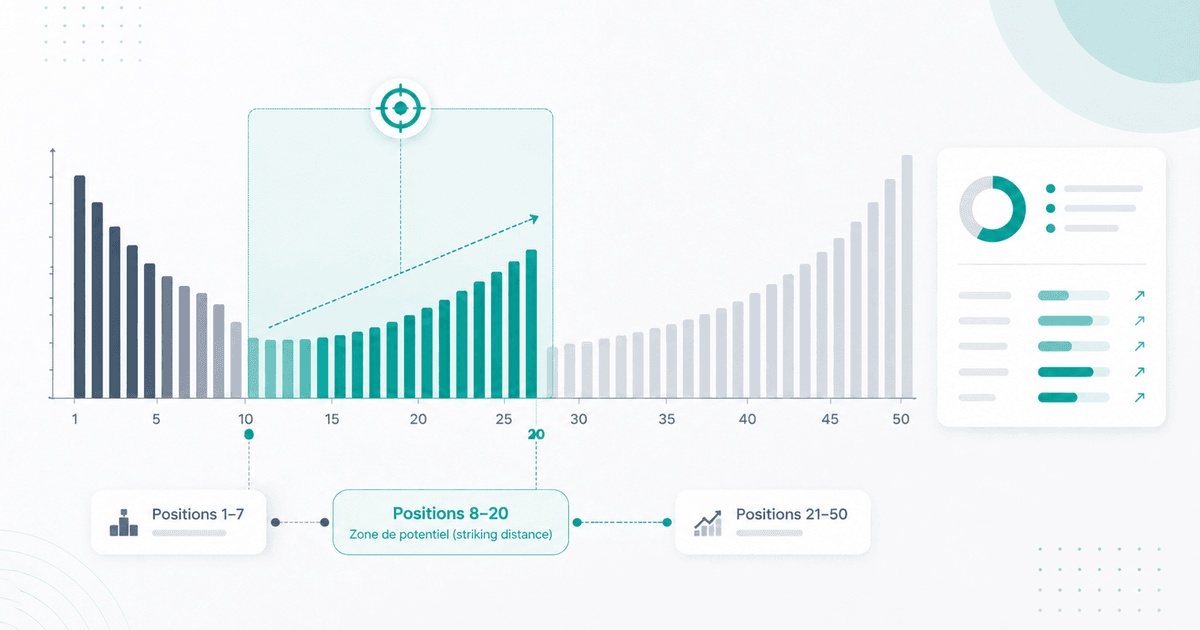
SEO Keyword Optimization: How to Turn Positions 8–20 Into More Clicks
Method to identify striking distance pages (positions 8–20) in GSC, prioritize high-potential URLs, and measure impact without getting misled by seasonality.